Weird Terminology
John Denker
1 How Names Should Be Used, or Not
A titmouse is not a mouse. Buckwheat is not wheat. As Voltaire
pointed out, the Holy Roman Empire was in no way holy, nor Roman, nor
an empire. Additional examples of weird terminology can be found in
section 2.
It is important to keep in mind the simple rule:
A name is not an explanation
or even a description.
|
|
|
|
Most names should be considered idiomatic expressions.
As such, they should not be taken literally.
Names exist for a reason. Many of the things we deal with on a daily
basis are not easy to describe in detail; it would take several
sentences or even several pages for a full description. A
fully-descriptive name would be far too long to be useful. Therefore
we have dictionaries, encyclopedias, glossaries, and cartographic
legends. We can look up a name or symbol to find out what it means.
It must be emphasized that ideas are primary and fundamental, while
terminology is tertiary. Terminology is important only insofar as it
helps us think about and talk about the ideas.
We get into trouble when the name is ambiguous (the same name applied
to multiple distinct ideas) ... or when the name appears to be
descriptive but is misleading.
- When confronted with misleading terminology, sometimes it
suffices to lift the ambiguity by using adjectives. For instance, if
we mean adiabatic in the sense of thermally isolated, we can always
say “thermally isolated” — and if we mean adiabatic in the sense
of non-sudden, we can always describe something as “non-sudden” or
“gradual” or “preserving corresponding states”.
- Sometimes it is necessary to coin new terminology. For example,
consider the contrast:
|
“Inaction” is the opposite of “action”, just as
“inaudible” is the opposite of “audible”. As a rule, in
English, the prefix “in–” negates the meaning of the word
that follows. Many, many words follow this rule.
|
|
“Inflammable”
means the same thing as “flammable”. The prefix “in–”
does not negate “flammable”, so this is an exception to the
usual rule. If you follow the rule, you will get the meaning
diametrically wrong.
|
|
|
|
The word “invaluable” does not negate the root word,
and indeed intensifies it.
|
It has long been known that the word “inflammable” is misleading to
a dramatically dangerous degree. Therefore there was a concerted
effort get rid of that word entirely, and to standardize on
“flammable”. However, related words such as “inflammatory” are
still extremely common.
- When confronted with terminology that is merely non-descriptive
(but not ambiguous or unduly misleading), trying to improve the
terminology is usually not worth the trouble. A name is not a
description, and never will be.
- As another way of expressing the same idea: Never judge a
book by its cover.
1.1 Birdwatching with the Feynmans
Richard Feynman was fond of pointing out that knowing the name of a
thing is not equivalent to understanding a thing. In reference 1
he wrote:
The next day, Monday, we were playing in the fields and this boy said
to me, “See that bird standing on the stump there? What’s the name of
it?”I said, “I haven’t got the slightest idea.”
He said, “It’s a brown-throated thrush. Your father doesn’t teach you
much about science.”
I smiled to myself, because my father had already taught me that [the
name] doesn’t tell me anything about the bird. He taught me “See that
bird? It’s a brown-throated thrush, but in Germany it’s called a
halsenflugel, and in Chinese they call it a chung ling and even if you
know all those names for it, you still know nothing about the
bird – you only know something about people; what they call that
bird. Now that thrush sings, and teaches its young to fly, and flies
so many miles away during the summer across the country, and nobody
knows how it finds its way,” and so forth. There is a difference
between the name of the thing and what goes on.
The result of this is that I cannot remember anybody’s name, and when
people discuss physics with me they often are exasperated when they
say “the Fitz-Cronin effect,” and I ask “What is the effect?” and I
can’t remember the name.
In my opinion, the young Feynman made a mistake by over-reacting.
Knowing the name of the bird does in fact tell you something.
First of all, there is a good chance that a brown-throated thrush is
related to other thrushes, and that tells you quite a lot, if you have
studied other thrushes. And even if this is the first thrush you’ve
ever seen, or even the first bird, knowing that it is a brown-throated
thrush allows you to look it up in reference books, and thereby find
out enormous amounts of information.
Names are a tool. As such, they can be used wisely or unwisely:
Just because a tool can be abused
does not mean you are obliged to abuse it.
|
|
|
|
1.2 Choosing Names
In general, you should not expect names to be descriptive ... and even
if you have a chance to give something a descriptive name, please do
not to overboard in that direction. For example, when naming the
variables and the subroutines in a computer program, oftentimes it
would take several sentences or several paragraphs to fully describe
what the thing does, which is too long for a convenient name. It is
better to give it a short name and then write into the documentation a
legend that says what the name means. For more on this, see
reference 2.
1.3 Multi-Word Phrases
Oftentimes, the meaning of a noun or verb is heavily modified by the
surrounding words, even if the core meaning remains more-or-less the
same. For example, consider
-
dollar bill,
- electricity bill,
- senate bill,
- et cetera
Here’s a more complex example. Consider the constrast:
|
X divided by Y has only one meaning:
|
|
X divided into Y has multiple
meanings, depending on context:
- 21 can be divided into 3 groups.
- 21 can be divided into groups of 3.
- Mathematicians say 3 divided into 21 is 7.
|
Note that in example (a) we have 3 groups of 7, while in example (b)
we have 7 groups of 3. Meanwhile, in examples (a) and (b) we have
X/Y=7, while in example (c) the fraction is upside down: Y/X=7.
Overall, inconsistent terminology gives rise to multiple problems:
- A minor problem is that if somebody asks you what a given word
means, it is impossible to give a concise answer. It all depends on
how the word is used.
- A much more serious problem is that if you know what a word means in
one context, you might assume it has the same meaning in another
context. This can lead to serious mistakes. It’s easy to have high
confidence in the wrong answer, which makes things even worse.
If you’re lucky, the intended meaning can be figured out by
sufficiently close reading of the sentence; the examples in this
section are in this category. However, things can get much worse than
that: Sometimes the meaning depends on the broader context, and
sometimes it’s just hopelessly ambiguous.
2 Some Examples
The following list gives some examples where the name of the
thing provides a conspicuously poor description of the thing
... or where the same word has multiple wildly-divergent meanings.
It should go without saying that this list is nowhere near complete.
These few examples should suffice to make the point that names are
not the same as descriptions, and you should not read too much
into a name.
-
- 1.
As mentioned in section 1, a titmouse is not a
mouse. It’s a bird.
- 2.
As mentioned in section 1, buckwheat is not
a kind of wheat.
Taxonomically, both wheat and buckwheat are in the plant
kingdom, but that’s as close as the relationship gets.
- 3.
As mentioned in section 1, the Holy Roman
Empire was in no way holy, nor Roman, nor an empire. See
reference 3.
- 4.
A peacock mantis shrimp is neither a peacock nor a
mantis. Also not a shrimp; they’re both soft-shell crustaceans, but
that’s as close as it gets.
- 5.
The Nazis called themselves the National Socialist
Workers’ Party, but they weren’t socialists. They hated socialists
and socialism; see reference 4 and reference 5.
- 6.
Even something as crucial and fundamental as the word
“and” has conflicting meanings:
|
In ordinary English, if somebody says A and B
and C and D are on top of the table, as we increase
the number of terms in the and-expression, the set of objects
gets larger.
|
|
In Boolean algebra and formal logic, the and
operator denotes the intersection of sets. If somebody speaks of
A and B and C and D, as we increase the
number of factors in the and-expression, the number of
objects gets smaller (or stays the same).
|
- 7.
The equal sign is also crucial and fundamental, yet
the meaning is context-dependent:
|
In mathematics, A = B means exactly the same thing as B
= A. It’s completely symmetrical, by definition.
|
|
In many
computer languages such as C++, fortran, or basic, the assignment
statement A = B means something wildly different from
B = A. There’s nothing symmetrical about it.
|
There are some rather serious misconceptions about this, having to
do with equivalence versus causation, in connection with the laws of
physics, as discussed in reference 6.
The Algol computer language uses the “:=” symbol for assignment
statements, which has an appropriately asymmetrical appearance.
Meanwhile, the Macsyma language (like its clone, Maxima) uses the
“:=” symbol for defining functions. Oddly enough, it uses a simple
“:” for assignment statements. This symbol has a less-than-ideal
symmetrical shape, but at least it does not directly conflict with
the mathematical “=” sign.
- 8.
|
Sometimes the term “in general” refers to something
that is generally true, i.e. typically true, but not always true.
|
|
Sometimes the term “in general” refers to something that is
true in all generality, i.e. absolutely, universally true.
|
Because of the ambiguity, I prefer to avoid the term (except in
negative constructions). Alternatives include saying “as a decent
rule of thumb” (if that’s what I mean) or saying “in all
generality” (if that’s what I mean). Very few things are true in
all generality; even the most basic theorems are subject to
important provisos, restrictions, and assumptions.
- 9.
A first-quarter moon is halfway to being a full moon.
- 10.
|
A north wind (aka northerly wind) blows
from the north. Similarly, when you are at the beach, a
sea breeze blows from the sea, and a land breeze blows
from the land.
|
|
An offshore breeze blows
toward the offshore area, and similarly an onshore
breeze blows toward the onshore area.
|
- 11.
|
The arrowhead on a barnyard weathervane points
into the wind, i.e. pointing to the direction the wind is
blowing from. The fletching and most of the shaft get blown to
the downwind side.
|
|
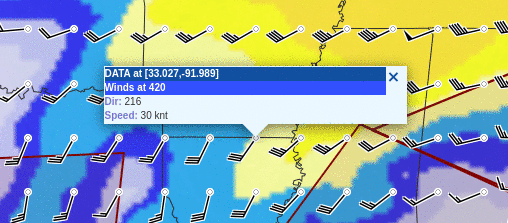
The wind indicators on a NOAA weather charts are
drawn from the station into the wind. The shaft is on the upwind side,
very unlike a weather vane. The barbs on the symbol resemble fletching
on an arrow. The arrow points downwind toward the station, again very
unlike a weathervane. See figure 3 and figure 4. Where it says “Winds at 420” (white on a blue
background) that refers to Flight Level 420, ı.e. 42,000 feet MSL.
|
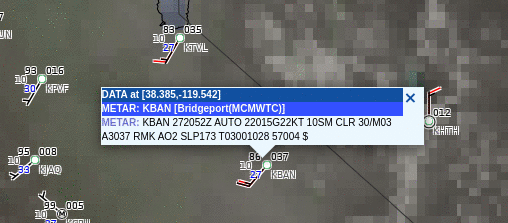 Figure 3
: Surface Observations : Barb Into the Wind
If you don’t think this is odd, try teaching it to a bunch of students
who think it’s simple and think they already understand it. See
reference 7.
- 12.
Asparagus fern is not a fern. Taxonomically, actual
ferns and asparagus ferns are both in the plant kingdom, but that’s
as close as the relationship gets.
- 13.
A naked mole rat is neither a mole nor a rat.
Rats and naked mole rats are rodents, but moles are not.
- 14.
A fisher cat is not in the cat family (felidae),
and has never been observed to catch or eat fish.
- 15.
The Jerusalem artichoke is not an artichoke and
doesn’t come from Jerusalem.
- 16.
|
As mentioned in section 1, the prefix
“in−” is widely used to form opposites. For example,
“inaction” is the opposite of “action”, and “invertebrate” is
the opposite of “vertebrate”.
|
|
The word “inflammable” means
the same thing as “flammable”. This does not conform to the
usual pattern. It is remarkably and dangerously misleading.
|
- 17.
|
In swimming, one lap is one length of the pool. It takes
two laps to get back to the starting place.
|
|
On a running track,
one lap is once around the track, back to the starting place.
|
- 18.
|
The races were sanctioned by the state council.
(Meaning approved.)
|
|
Two of the runners
were sanctioned by the state council. (Meaning disapproved and
penalized.)
|
- 19.
|
We speak of the “alkali metals” as being disjoint
from the “alkali earths”.
|
|
The alkali earths are perfectly good metals.
|
- 20.
|
Weak tea means dilute, and strong tea
means concentrated, as you would expect. The same terminology
applies to weak and strong alcoholic beverages.
|
|
A strong acid has
a high Ka (and therefore low pKa). That means you can have a dilute
solution of a strong acid or a concentrated solution of a weak
acid.
|
- 21.
Given that “acid” is pretty much the
opposite of “alkali”, you might imagine that “acidity” would be
the opposite of “alkalinity”, but it’s not. The alkalinity of a
weak base is proportional to concentration, but the acidity of a
weak acid is not (assuming the concentration is not too low).
Constructive suggestion: It helps to avoid the term “acidity” as
much as possible. If you mean low pH, say low pH.
The whole notion of “alkalinity” (aka “total alkalinity”) always
struck me as unsophisticated and underspecified. Buffer behavior is
complicated, not easily characterized by a single number. Sometimes
you care about the local height, and sometimes you care about the
area under the curve.
- 22.
In nuclear physics, you can have fast neutrons and
you can have prompt neutrons. But fast does not imply prompt, and
prompt does not imply fast. See reference 9.
- 23.
The opposite of fast neutrons is thermal neutrons
(not slow neutrons). See reference 9.
- 24.
Fast reactors, including fast breeder reactors, do
not breed quickly or do anything else quickly. They make use of fast
neutrons. See reference 9.
- 25.
The alternative to a boiling-water reactor (BWR) is a
pressurized-water reactor (PWR). But a boiling-water reactor is
pressurized, too. See reference 9.
- 26.
|
Astronomers use the name “metals” to apply to any
elements other than hydrogen and helium.
|
|
Chemists, metallurgists,
and ordinary folks share a notion of “metal” that is
very much narrower than the astronomers’ notion.
|
- 27.
|
In the context of an electrical harmonic oscillator,
such as one standing-wave mode of the electromagnetic field, we say
that the Nth energy eigenstate has N “photons” in it. The
operator a†a is the photon-number operator. These
photons do not propagate at the speed of light; indeed they do not
propagate at all. They are standing waves ... or in the case of
the simple harmonic oscillator, not really waves at all.
|
|
In the
context of a propagating wave, a “photon” is a wavepacket,
typically a Gaussian wavepacket, with some not-too-large spread in
position and also some not-too-large spread in momentum.
|
- 28.
A photomultiplier tube does not multiply photons. It
basically consists of a wimpy little photo-electron emitter,
followed by an N-stage electron multiplier. You can think
of it as a photo-electron-multiplier. (The same sort of electron
multiplier is used in mass spectrometers, where the first-stage
input is an ion, rather than a photo-electron.)
- 29.
|
The so-called “first ionization
energy” should really be called the “first cationization
energy”. It applies when you are removing an electron.
|
|
If you
are making an anion, i.e. adding an electron, you should use the
“electron affinity” instead.
|
- 30.
|
We speak of “oxygen” (from the Greek, meaning literally
“acid former’) and “halogens” (literally “salt formers”).
|
|
For
every salt there is a corresponding acid, and for every acid there
is a corresponding series of salts. So how can oxygen and halogen
be disjoint notions? Every acid-former should also be a
salt-former, and vice versa.
|
- 31.
|
We speak of the “rare earths”.
|
|
They are not
particularly rare. For example, cerium is slightly more abundant
than copper.
|
- 32.
|
The noun “day” can refer to the hours of daylight
(roughly a 12-hour day).
|
|
It can also refer to the complete 24-hour
cycle.
|
|
Ditto for the adjectives “daily” and “diurnal”. As far as I
can tell the ambiguity has existed for centuries, dating back to the
Latin dies and diurnus.
|
- 33.
|
Bimonthly “usually” means once every two
months.
|
|
According to the American Heritage Dictionary, it can also
mean twice per month. On the other hand, other dictionaries label
the latter definition as rare or erroneous.
|
|
This is a contranym. The same ambiguity arises for other words
such as biweekly.
|
- 34.
|
In one of its meanings, ravel is the opposite of
unravel.
|
|
In another of its meanings, ravel is exactly the same as
unravel.
|
- 35.
|
We speak of cooking things “in the microwave”.
|
|
That refers to a microwave oven, which is an oven, not a microwave
(nor, indeed, a wave of any kind).
|
|
|
|
The microwaves in such an oven have a wavelength that is not
microscopic, is not micron-sized, and is in fact much longer than the
wavelength of the waves that do the cooking in a plain old broiler.
|
- 36.
|
Sometimes “X-ray” refers to a particular part of the
electromagnetic spectrum.
|
|
Sometimes “X-ray” refers to an image made
using this part of the spectrum.
|
- 37.
|
I recently cooked some “French fries”. I cooked
them in the oven,
in accordance with instructions on the package.
|
|
That resulted in “French fries” that had never been fried and had
never been anywhere near France.
|
- 38.
|
I recently bought some Mexican oregano
(Lippia graveolens).
|
|
It wasn’t oregano (Origanum vulgare) and it had
never been in Mexico.
|
- 39.
|
Wish-Bone sells something called “French dressing”.
|
|
It doesn’t come from France, and does not resemble
anything commonly served in France.
|
- 40.
The meaning of the word “organic” is heavily dependent
on context:
-
“Organic chemistry” is a two-word idiomatic expression.
- “Organic vegetables” is a two-word idiomatic expression.
- “Organic disease” is a two-word idiomatic expression.
- “Pipe organ” is a two-word idiomatic expression.
None of these four meanings have much in common nowadays. They are
all rather distantly related to the original root, namely
instrument or mechanism.
Neither the chemists nor the physicians should be telling the
farmers how to define farming-related terms ... and vice versa, in
all combinations.
- 41.
In chemistry, the technical definition of “aromatic”
is highly technical, idiomatic, and far removed from the ordinary
nontechnical meaning.
- 42.
|
In mechanics, we speak of “kinetic energy”
as being disjoint from “potential energy”.
|
|
In thermodynamics, we
speak of the “chemical potential”. A large part of the chemical
potential consists of kinetic energy.
|
- 43.
|
In physics, conservation of momentum
means that the amount of momentum in a region cannot change except
insofar as it flows across the boundary. See equation 1.
Energy, momentum, and electrical charge are always strictly
conserved.
|
|
In a non-technical context, conservation means something
very different, namely avoiding waste. For example: conservation of
endangered wildlife.
|
- 44.
|
In physics, the notion of energy is fundamental
and very important. It is a state function, i.e. a function of the
state of a give system or parcel.
|
|
The homespun term “energy”
refers to something else. It is not the physics energy, or even the
thermodynamic free energy. Roughly speaking, it is the amount of
thermodynamically available energy. It is not a function of
state, since it depends on the parcel’s surroundings.
|
|
Along with item 43, this
shows that in the expression “conservation of
energy”, both the word conservation and the word energy have
dramatically different meanings, depending on whether you are
speaking in physics terms or homespun terms.
|
- 45.
|
We speak of the “free energy”.
|
|
Although
it has dimensions of energy, it is not the actual energy.
|
|
|
|
Also, it’s not free, since you usually have to pay for it.
|
- 46.
|
By itself, the word radio brings to mind
electromagnetism in the kHz to MHz part of the spectrum, where the
energy is 5×10⁻¹¹ to 5×10⁻⁷ eV per photon.
|
|
The
term radioactivity, which comes from the same root, brings to
mind photons and particles with energy above 105 eV per
particle.
|
|
So radioactivity is separated from
radio by 12 orders of magnitude.
|
- 47.
|
The term “bedlam” refers to uproar and confusion.
|
|
The word is derived from “Bethlehem”, which carries no such
meaning.
|
- 48.
|
In molecular spectroscopy we speak of
“internal conversion”.
|
|
The conversion is not usually internal to the molecule.
|
- 49.
|
Originally, “elastic” meant capable of returning to its
original size and shape after being stretched. This meaning is
still common in technical meanings such as the elastic limit of a
spring, and in many nontechnical meanings such as an elastic band in
clothing. In this sense, rubber is far more elastic than steel.
|
|
In physics there is another, much narrower meaning: we speak of an
inelastic collision between two soft rubber balls, even if the two
balls return to their original shape. In this sense, steel has a
far greater coefficient of elasticity than rubber.
|
- 50.
|
In the printing trades, and in the physics lab, the colors
red, green, and blue are very different from the colors cyan,
magenta, and yellow.
|
|
In, say, a clothing store, cyan is considered
a shade of blue. If you want a cyan-colored shirt, you should ask
for blue (or bright blue); if you ask for cyan the clerk probably
won’t understand you. If you want a technically blue-colored
shirt, you might ask for deep blue.
|
- 51.
|
The SI “mole” is defined as the base unit for “amount
of substance”. This is a subtle, highly abstract notion. It is
much older than atomic theory, and does not depend counting
particles of any kind.
|
|
Nowadays a lot of people define “mole”
in terms of Avogadro’s number. A mole is a number,
like a dozen (only larger).
|
|
For all practical purposes, a mole is equal to the
number of 12C atoms (or the “amount of substance”) in twelve
grams of 12C. However, twelve kilograms would have
made SI more consistent. One occasionally sees definitions of the
terms gram-mole and kilogram-mole, but these are not SI terms and
are vanishingly rare in practice.
|
- 52.
|
In some situations, adiabatic means fast enough
... so that there are no appreciable heat leaks through the
boundary.
|
|
In some situations, adiabatic means slow enough or
gentle enough ... so that there is a one-to-one correspondence between
initial states and final states, with no change in occupation numbers.
This is the opposite of the “sudden” approximation.
See reference 10.
|
- 53.
|
In thermodynamics, experts use at least four or five
mutually-inconsistent reasonable technical definitions of “heat”,
each of which has its advantages and disadvantages. See
reference 11.
|
|
Four or five different reasonable technical
definitions is bad enough, but there are also innumerable
less-reasonable, non-technical, and/or metaphorical uses of the
word.
|
- 54.
|
Rock candy is not made of rock.
|
|
Rock wool is not made of
wool.
|
|
Milk of magnesia is not made of milk.
|
|
Chocolate turtles are not made of turtles.
|
|
This goes to show that the English
language’s rules for forming appositives are rather loose.
|
- 55.
|
In the terms “frequency spectrum” and “mass
spectrometer”, frequency and mass (respectively) are the
abscissa of the spectrum.
|
|
In the terms “power spectrum” and
“emission spectrum”, power and emission (respectively) are the
ordinate of the spectrum.
|
- 56.
|
Sometimes “spin zero” means s=0, which is related
to the eigenvalue of the S2 operator.
|
|
Sometimes “spin
zero” means ms=0, which is the eigenvalue of the Sz
operator.
|
|
It is not hard to construct sentences which use the word “spin”
with two different meanings in the same sentence. It is not hard to
get thoughtful experts to accept such sentences at face value, even
after being warned that a trick question is coming.
|
- 57.
|
We speak of electrons “flowing” in a wire. Also, since
electrons carry charge, we speak of charge “flowing” in a wire.
Charge density appears on the LHS of equation 1.
“Flow” means that charge is being carried from place to place.
|
|
We
speak of current “flowing” in a wire. Current density appears
on the RHS of equation 1. “Flow” does not mean
that current is being carried from place to place.
|
|
The equation for continuity of flow is:
|
| | = − ∇·j
(1) |
|
- 58.
Although the ambiguity of “flow” as mentioned
in item 57
isn’t very troublesome when restricted to the “flow” of charge or
the “flow” of current, it becomes much more serious when we talk
about the “flow” of momentum. A vortex in a fluid is a pattern
of flow, wherein the fluid flows around and around. But what do we
say if the vortex itself is being carried from place to place? Is
that the flow of flow? See also reference 12.
- 59.
|
When drawing the vector that represents an
electric dipole moment, physicists, mathematicians, and some (but
not all!) chemists draw it in a way that is consistent with the
orientation of position vectors.
|
|
Some chemistry books (especially
at the introductory level) draw the arrow the other way. This makes
no sense, but they do it anyway. See reference 13
for details.
|
- 60.
|
Suppose we have two parallel plates, with a
charge Q/2 on each of them. We say there is a charge Q on the
pair of plates, referring to the actual total charge.
|
|
Suppose we
have a parallel-plate capacitor, with a charge +Q on one plate and
a charge −Q on the other plate. It is conventional (but unwise)
to say there is a “charge” Q on the capacitor.
|
|
There are innumerable intermediate cases.
|
|
I strongly recommend reserving the term “charge” for the
real total charge.
|
|
Constructive suggestion: We can use the term
gorge to represent the capacitor situation. We can speak of
gorging and disgorging the capacitor. See reference 14.
|
- 61.
In mathematics, the term “linear” has multiple
inconsistent meanings.
|
The term “linear equation” covers things like y = m x +
b.
|
|
The term “linear transformation” covers the mapping from x to
m x but does not include the mapping from x to m x + b
(unless by some miracle b is identically zero).
|
To avoid the inconsistency, the easiest thing is to avoid the term
“linear” entirely. You can refer to y = m x + b as an
affine relationship and refer to y = m x as a
proportionality relationship.
- 62.
True north ... versus magnetic north ... versus polar grid
north.
- 63.
Consider the following pattern:
|
sin4(x) | | = | | [ sin(x) ]4 | | as expected |
|
sin3(x) | | = | | [ sin(x) ]3 | | as expected |
|
sin2(x) | | = | | [ sin(x) ]2 | | as expected |
|
sin−1(x) | | = | | arcsin(x) | | surprise! |
| | | ≠ | | [ sin(x) ]−1 | | surprise!
|
| (2)
|
In other words, you might expect sin−1(x) to be the
multiplicative inverse of sin(x), but instead it is more-or-less
universally interpreted to mean the functional inverse,
i.e. the inverse function.
Similar words apply to other trigonometric functions (cosine,
tangent, cotangent, et cetera).
- 64.
The “Dirac delta function” is not a function,
according to the mathematical definition of function. It could
more properly be called a delta distribution, but almost nobody
calls it that.
- 65.
|
When a switch is closed, electrical
current can flow.
|
|
When a valve is closed, no fluid can flow.
|
- 66.
In classical mechanics, a closed system cannot
exchange matter or energy with its surroundings; in thermodynamics
this would be called an isolated system. In thermodynamics,
especially as practiced by chemists, a closed system is closed with
respect to matter but can still exchange energy with its
surroundings.
- 67.
In mathematics, even just within topology, there
are multiple definitions of “closed”.
- In topology, a manifold is “closed” if it is compact and
without boundary.
- In point-set topology, a set is “closed” if it contains
all its limit points.
- In differential topology, a one-form is “closed” if its
exterior derivative vanishes everywhere.
- 68.
|
In mathematics, the term “field” could refer to a
vector field.
|
|
Or it could refer to a Galois field.
|
- 69.
The word “algebra” has many inconsistent meanings.
- High-school algebra – a field of study
- Abstract algebra (groups, rings, etc.) – a field of study
- Algebra i.e. a vector space with multiplication – a mathematical
structure
- Boolean algebra – another structure
- Sigma algebra – yet another structure
For more examples, see reference 15. It’s hard to see what
these different algebras have in common. In particular, it’s hard
to predict what sorts of mathematical structures will be called
algebras and which won’t.
Even in the context of high-school algebra, the word has two
different meanings: Fundamentally, algebra is a language for
expressing rules, patterns, and generalizations. However, when
most people hear the word “algebra” they think of solving
equations to find x.
- 70.
|
In mathematics, an element y of a group is called
“primitive” if every element of the group is equal to some power
of y. For example, in the group of integers mod 7, the
element 3 is primitive, while the element 2 is not.
|
|
Let F be the
field of polynomials over some base field G. An element P of
F is called “primitive” if every element of the field (F mod
P) is equal to some power of the monomial x. For example,
x2+x+1 is primitive in the field of polynomials over GF[2], but
it is not primitive in the field of polynomials over GF[5].
|
|
This is demonstrably a source of real (not hypothetical)
confusion. A well-known cryptography book quoted one definition of
“primitive” in a context where the other definition was required.
|
- 71.
|
The term “generator” is also ambiguous. According
to one definition, the element y in item 70 is called a
“generator” of the group.
|
|
Let F be the field of polynomials
over some base field G. Let P be an irreducible element of F.
Then P is called the “generator” of the field (F mod P).
|
|
|
|
(IMHO it would be good to do away with this usage, and instead call
P the modulus.)
|
- 72.
|
“Event” in spacetime, in physics.
|
|
“Event” in statistics.
|
- 73.
|
“Sample” in chemistry.
|
|
“Sample” in statistics.
See reference 16.
|
- 74.
|
“Gravity” in the sense of framative gravity.
|
|
“Gravity”
in the sense of massogenic gravity. See reference 17.
|
- 75.
|
“Acceleration” (the vector).
|
|
“Acceleration”
(the scalar). See reference 18.
|
- 76.
|
Some argue that any transfer or transformation of
energy should count as «power» ... but I’m not sure
advection should count. For example, consider a slow leak in
the gas tank of a car. Does that count as «power»? I’ve
pretty much given up. I consider this one of the supposedly
technical terms that doesn’t have any clear meaning. Anybody
who wants to use it should explicitly specify the intended
meaning.
|
3 References
-
-
Richard Feynman,
“What is Science”
(an address to the National Science Teachers Association)
The Physics Teacher 7, 6, 313–320 (1968).
http://www.fotuva.org/feynman/what_is_science.html -
John Denker,
“Suggestions for Writing Good Software”
www.av8n.com/computer/htm/good-software.htm -
Voltaire, Essai sur l’histoire générale et
sur les mœurs et l’esprit des nations, Chapter 70 (1756).
-
David Emery, “Were the Nazis Socialists?”
https://www.snopes.com/news/2017/09/05/were-nazis-socialists/ -
Ronald J. Granieri,
“The right needs to stop falsely claiming that the Nazis were socialists”
https://www.washingtonpost.com/outlook/2020/02/05/right-needs-stop-falsely-claiming-that-nazis-were-socialists/ -
John Denker,
“Cause and Effect”
www.av8n.com/physics/causation.htm -
https://www.aviationweather.gov/windtemp
-
Wiktionary has a list containing more than
a hundred contranyms:
https://en.wiktionary.org/wiki/Category:English_contranyms -
John Denker
Nuclear Reactions : Miscellaneous Notes
www.av8n.com/physics/nuclear-reactions.htm -
John Denker,
“Modern Thermodynamics”
./thermo/ -
ibid., the chapter on “Heat”
./thermo/heat.html -
John Denker,
“A Non-Sneaky Derivation of Euler’s Equation”
www.av8n.com/physics/euler-flow.htm -
John Denker,
“The Electric Dipole Moment Vector –
Direction, Magnitude, Meaning, et cetera”
www.av8n.com/physics/electric-dipole.htm -
John Denker,
“Gorge versus Charge”
www.av8n.com/physics/gorge-vs-charge.htm -
Wikipedia article, “Algebra (disambiguation)”
http://en.wikipedia.org/wiki/Algebra_(disambiguation) -
John Denker,
“Introduction to Probability”
www.av8n.com/physics/probability-intro.htm -
John Denker,
“Weight, Gravitational Force, Gravity, g, Latitude, et cetera”
www.av8n.com/physics/weight.htm -
John Denker,
“Velocity, Speed, Acceleration, and Deceleration”
www.av8n.com/physics/acceleration.htm